
Context
Context: Internal web tool used by ISB Global staff to create customer inquiries, log service issues, and trigger workflows across waste & recycling operations. The tool was widely used but had grown complex over time.
Tools: Figma, Photoshop, user surveys, usability testing: The project aimed to enhance the user experience within the CRM module by addressing limitations in the current workflow for the creating and managing Business Partners processes.
Tools: Axure RP, user surveys, usability testing.


Problem
Sales users lacked the necessary access to the Backoffice system to create Business Partners and Contacts during the creating and managing Business Partners processes in CRM. This dependency on Backoffice caused delays and additional effort, particularly when dealing with Potential Business Partners who needed conversion into Business Partners for further actions. The absence of an integrated approach disrupted the user experience and did not align with the goal of maintaining an efficient, self-contained workflow within CRM.

My Contribution
Redesigned the CRM workflow so staff could create Business Partners and Contacts directly within CRM without needing Backoffice access. This included analysing dependencies, simplifying the user journey, and ensuring all updates aligned with system configuration rules and access levels.
Ran quick moderated usability tests with operational staff and iterated based on feedback.
Added new Inquiry fields for Customer Type and Contact information, exploring optimal placement and grouping to minimise user error and improve clarity.
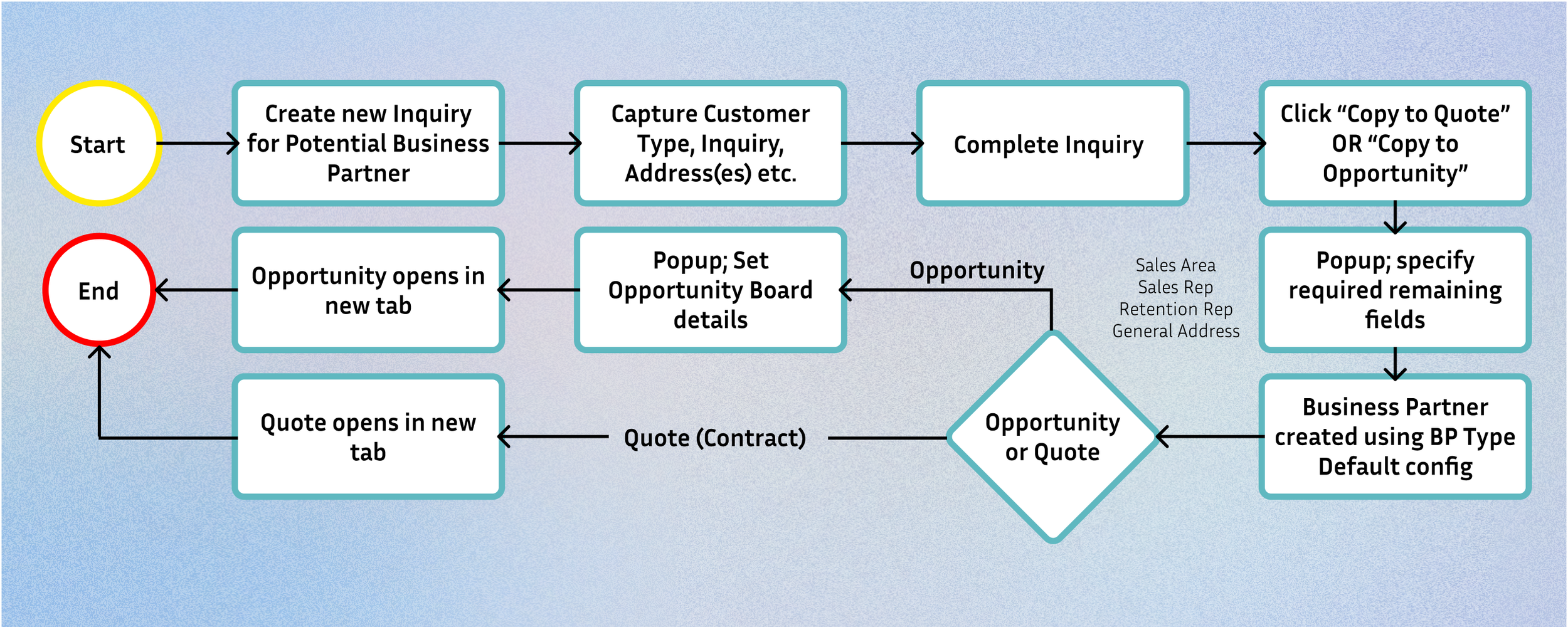
Introduced pop-up windows for key processes (e.g., Partner Conversion, Copy to Quote, Copy to Opportunity) to keep users in context and avoid page switching. Pop-ups dynamically captured the essential data required while automating everything else in the background.
Leveraged BP Type Default configurations to automate population of complex fields. Users now enter only minimal information, while services handle the creation of General or Customer Business Partners based on predefined rules.
Created basic wireframes to map out the new end-to-end journey, exploring structure, spacing, tab layouts, and field grouping.
Conducted low-fidelity prototype testing with stakeholders to validate the proposed flow, identify usability issues, and gather early feedback.
Implemented improvements based on feedback, including clearer labels, contextual help within pop-ups, and progress indicators for multi-step actions.
Refined layout and visual structure, improving spacing, hierarchy, and navigation clarity to reduce cognitive load.
Outcome
42% reduction in time-to-create a new inquiry.
35% decrease in form submission errors.
Staff reported the new layout felt “much clearer and faster.”
Improved consistency helped onboarding new employees more easily.
Resulting design:
The final solution delivered a fully streamlined, end-to-end process entirely within CRM which allowed staff to convert Potential Business Partners into active Business Partners or Customers, create Contacts and manage Quotes or Opportunities without needing Backoffice access.


Problem
Context: Internal web tool used by ISB Global staff to create customer inquiries, log service issues, and trigger workflows across waste & recycling operations. The tool was widely used but had grown complex over time.
Tools: Figma, Photoshop, user surveys, usability testing: The project aimed to enhance the user experience within the CRM module by addressing limitations in the current workflow for the creating and managing Business Partners processes.
Tools: Axure RP, user surveys, usability testing.
Problem
Sales users lacked the necessary access to the Backoffice system to create Business Partners and Contacts during the creating and managing Business Partners processes in CRM. This dependency on Backoffice caused delays and additional effort, particularly when dealing with Potential Business Partners who needed conversion into Business Partners for further actions. The absence of an integrated approach disrupted the user experience and did not align with the goal of maintaining an efficient, self-contained workflow within CRM.
My Contribution
Redesigned the CRM workflow so staff could create Business Partners and Contacts directly within CRM without needing Backoffice access. This included analysing dependencies, simplifying the user journey, and ensuring all updates aligned with system configuration rules and access levels.
Ran quick moderated usability tests with operational staff and iterated based on feedback.
Added new Inquiry fields for Customer Type and Contact information, exploring optimal placement and grouping to minimise user error and improve clarity.
Introduced pop-up windows for key processes (e.g., Partner Conversion, Copy to Quote, Copy to Opportunity) to keep users in context and avoid page switching. Pop-ups dynamically captured the essential data required while automating everything else in the background.
Leveraged BP Type Default configurations to automate population of complex fields. Users now enter only minimal information, while services handle the creation of General or Customer Business Partners based on predefined rules.
Created basic wireframes to map out the new end-to-end journey, exploring structure, spacing, tab layouts, and field grouping.
Conducted low-fidelity prototype testing with stakeholders to validate the proposed flow, identify usability issues, and gather early feedback.
Implemented improvements based on feedback, including clearer labels, contextual help within pop-ups, and progress indicators for multi-step actions.
Refined layout and visual structure, improving spacing, hierarchy, and navigation clarity to reduce cognitive load.
Outcome
42% reduction in time-to-create a new inquiry.
35% decrease in form submission errors.
Staff reported the new layout felt “much clearer and faster.”
Improved consistency helped onboarding new employees more easily.
Resulting design:
The final solution delivered a fully streamlined, end-to-end process entirely within CRM which allowed staff to convert Potential Business Partners into active Business Partners or Customers, create Contacts and manage Quotes or Opportunities without needing Backoffice access.
Final Designs

The final product made a streamlined processes entirely within CRM, ensuring seamless functionality aligned with user roles and system configurations. Key highlights included:
Simplified process of converting Potential Business Partners to Business Partners or Customers directly within CRM, eliminating the need for Backoffice access.
Introduced intuitive pop-up windows to guide users through the "Copy to Quote" and "Copy to Opportunity" processes, capturing key information dynamically.
Product Success

Validation:
Eliminated the dependency on Backoffice access, significantly reducing workflow bottlenecks for Sales users.
Received validation from stakeholders, highlighting increased productivity and satisfaction.
What I Learned

Regular feedback from the Functional Analysts team helped tailor the design to their specific needs showed me the importance of collaboration
Working within CRM system limitations to deliver an integrated solution without requiring Backoffice showed me how to handling technical constraints.